Caring for Chihuahuas
Chihuahua Rescue Victoria dogs can be returned to us
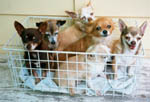
If you a adopt a rescued Chihuahua, we give you written instructions on how to care for your new family member. We explain to you what we have been able to learn about the little dog and how best to handle his or her particular problems if any. If an adopting family change their minds for some reason, we request you return the dog to us as we are well equipped to find them a new home.
Please do not turn them loose, dump them at a pound, or advertise them "free to good home" as none of these options are safe for the dog or even give them much chance of ever finding a good home - whereas if you return them to us, we will find them a good home. We make an open offer to baby-sit your adopted dog if you go on holiday or have to spend time in a hospital etc.
Some of these little dogs have been greatly traumatised by their experiences and mostly we can only guess at some of the horrors they have experienced. There is only one way to treat them - with lots of love!
Update your will to include your pets

We have plenty of notes on this page about how to care for a Chihuahua physically, but that isn't all. Your pets should also be accounted for in your will so that if anything happens, your wishes will be clear about what arrangements need to be made for them. Read more about this on our 2015 Newsletter: Provide for your Chihuahua after you have gone.
Feeding a Chihuahua

Due to the Chihuahua's very small size these little dogs require feeding more often than much larger dogs. The very small Chihuahua requires feeding regularly and often, whereas the larger ones do not require feeding as often. When deciding the size of a Chihuahua it is best to judge by weight, but also look at the bone structure. A Chihuahua below 1.5 kg in weight with a very fine bone structure will require feeding smaller amounts four hourly, if not more often. 1.5 kg to 2 kg with very fine bone structure will require feeding at least three times each day, while a good solid bone structured little dog of more than 2 kg can easily get by on twice daily feeds. These little dogs have very small stomachs so are unable to digest huge quantities of food in one sitting. When it is not possible to be home to feed often we use pasta, rice, and porridge to thicken their meals.
There are commercial dog foods that are suitable to feed a Chihuahua, but you need to be very aware that the salt content in many dog foods is far too high for a tiny little body to cope with, and the high salt content will slowly kill the dog. Bear in mind the Chihuahua is a very small animal and can fade very rapidly in a matter of hours! Some signs to watch out for when feeding commercial dog foods are sporadic vomiting, wind, diarrhoea, continual scratching, dullness of coat, or any one of these symptoms. Salt is used as a preservative so be very wary when selecting a commercial dog food. Salt affects the kidneys and the heart muscle in small dogs.
Chihuahua Rescue Victoria has always prepared the food for our little rescues using a good quality beef, pasta, rice, rolled oats, oils, green and yellow vegetables and some fruits. This stew is fed daily (or twice daily if required) with some chopped cooked chicken and some raw beef on top. A good quality dried commercial dog food is constantly available all day for the dogs to "graze" on. Read more about this on our Chihuahua suggested diet section below.
Any little "sickly" dog is given daily doses of a good quality vitamin/mineral supplement such as Nutrigel. The really small ones are fed an additional "stew" meal midday. We give a raw human quality lamb or beef bone every few days to exercise their jaws and this aids in keeping their teeth clean. A home made bone broth can also be made and a half teaspoon of this jelly can be given with their food once daily.
The really old dogs are fed similarly to the very small Chihuahua, smaller feeds more often. We have found that despite their lack of teeth, they still like to "mouth" a small raw bone. We also give them a small amount of the bone broth jelly. We put dried food down for them: they "mouth" the dried food and soften it with their saliva. If they still have trouble we soak the dried food with a little warm water to soften it a little.
Chihuahua suggested diet
See the chihuahua recipes for the actual recipes we cook for our Chihuahuas.
This section was also featured as our Chihuahua Suggested Diet newsletter. We are often asked what we feed our little rescue dogs. Each week we make up a stew which can be frozen into individual serving sizes.
The Chihuahua is a dog - despite its size - and must be fed like a dog, not a human. Human food is too processed and will rot their teeth rapidly. Definitely do not feed them cured meats such as bacon, ham etc. Never give them human milk products or chocolates. Nor should you feed them potatoes, onions, grapes or garlic.
Here are the recipes that we use for our rescue dogs - Chihuahua Rescue Stew, Grain Free Stew and Bone Broth.
Please note: we are removing garlic from our stew recipe and we are no longer using it in our stews either. The reason for this is that garlic is a member of the onion family and thus toxic to dogs in larger quantities, and especially to Chihuahuas. Some people understand a clove to be the whole head of the garlic bulb, but what we meant was just one little piece of it. To avoid confusion, we are removing it all together.
You can download PDFs of the recipes for your own reference:
- Chihuahua-Recipes_Chihuahua-stew.pdf.
- Chihuahua-Recipes_Grain-free-stew.pdf.
- Chihuahua-Recipes_Bone-broth.pdf.
- Chihuahua-Recipes_Dog-biscuits.pdf.
General feeding tips
If we have a dog eating their own poo, we mix one egg into a half cup of crushed pineapple and put it into the hot food (it will not harm any of the dogs). It makes their poo highly distasteful to them and they will stop eating it immediately.
If the Chihuahua is a tiny fragile type you may need to feed it several times daily or give it some sugared water or honey to avoid fainting spells. After they have decided to eat the stew then you should start their doggie regime: one or two small servings of the stew per day; half a cup of dried dog food each day; raw beef or lamb bones can be given and allow them to gnaw on these for teeth and jaw exercise. Your dog will love it!
You can offer any sort of chopped fruit (except grapes) whenever you have some, but in very small quantities.
Chihuahuas have a very fine bone structure, especially in the bottom jaw, so there is very little support for holding teeth in place. Proper "doggy" food will aid in keeping your little dog's teeth, bones and heart far more healthy. This diet teaches them to CHEW and so helps strengthen their jaw bones and teeth.
Remember that a sudden change of diet may cause an upset tummy, so introduce new diets slowly and gradually.
Purchase a jar of unprocessed pure honey from the fruit shop (supermarket honey is far too processed), and keep it on hand at all times. A good finger scoop rubbed on the roof of the mouth will bring a little one out of a "sugar drop" and could avoid a death.
Supplements
Sometimes, we have a Chihuahua who has extremely dry, itchy or flaky skin and I will give the dog flax seed or fish oil - but you must check with your vet first to make sure it is OK for your Chihuahua.
If you are unsure about any other supplements you're thinking of using, always check with your vet first to make sure it is OK for your Chihuahua - we want to keep them safe!
Bathing
These little dogs do not require bathing very often. Too many baths and their coats tend to become very dry and lose most of its lustre and shine. A good brush daily will ensure dead hair and any flaky skin etc. is removed without harm to the dog or its coat, and will help with the growth of new hair.
Some people believe that the short coat Chihuahua does not require the same amount of grooming as those with a long coat. I believe this to be incorrect. I have found that the smooth coats still shed dead hair etc. and this needs to be brushed out to keep the coat nice and shiny and prevent skin itchiness.
A good lukewarm bath with a doggy shampoo is always required if the dog is extremely dirty, smelly, and riddled with fleas. We see quite a number in this state when first rescued.
Exercise
Chihuahuas are an active breed and most definitely need exercise. Exercise should always go with a good diet.
General tips
- As with all things, exercise requires moderation and Chihuahuas will likely tire before you. The aim isn't to exercise until you are tired! Over exercise can contribute to injuries and health complaints too.
- For any Chihuahua who is new to exercise, introduce them to it gradually to allow them to get used to it.
- Harness or collar? Harnesses are much better then collars for smaller dogs in particular. A dog that pulls on the leash may choke itself on a collar. Small dogs tend to have more delicate necks and risk damaging their neck (including tracheal collapse). The Upper Paw blog post Collars vs Harnesses: Which is Best? has some good information on this.
- Be sure to keep your Chihuahua close enough during walks that you can react to any problems that occur. Retractable leashes offer much convenience but if your dog is two or three metres away when something happens you will not be able to save them. For example: another dog attacks or your dog decides to run on the road.
- Dogs will play all day long, inside and outside. You must have a securely fenced space for them to play outside.
- On boiling hot days, only take them out early in the morning or late in the evening when it is not so hot. Smaller dogs like Chihuahuas will dehydrate faster. Take a little bowl and some water with you. Asphalt, sand and concrete can be really hot so avoid those surfaces on hot days.
- If you live in a super cold area, take precautions. If your dog gets wet, make sure to get home fast and get the dog warm and dry. Get the dog a coat etc so that they won't suffer from being outside and still can get some exercise. If it's raining or snowing, don't force the dog outside. Play inside.
- Walking around the block is great - but even better is a trip to a dog friendly park! This lets our Chihuahua get some exercise and get socialised around other dogs. Here is one good site for finding dog friendly parks and beaches in Victoria: victoriawalks.org.au.
- Chihuahuas love going for walks, but they will take their signals from you. Walking the dog is fun for you too! Let your dog feel excited to go for a walk, give them attention while putting the leash and harness on.
- Watch your dog. If they start limping or are in pain, do not push them and take the dog to a vet ASAP.
- Dogs can get very nervous around traffic, and heavily populated areas. It might take time to get your dog used to these conditions, so try to introduce them gradually to the daily conditions under which you will walk them. Choose a route that is not so busy for example, until you are confident that your dog will be OK in the other spaces.
- Avoid areas that may have been treated with lawn care chemicals. These are harmful to our best friends!
- Very important for small Chihuahuas: they must be watched closely for sugar drop if walking, so always carry a small container of honey with you.
Puppies
Puppies naturally have a tonne of energy, and exercise will help them (and you) deal with that! Physical activity helps their developing bodies, but be aware that over exercise can be quite harsh since their joints and sockets are not fully formed. Slowly introduce them to exercise; allow them to develop endurance for walking and play.
2 to 4 Months
Don't take your puppy out to public areas until they have had all their shots. Use really short walks and play with them a lot inside and outside.
4 to 8 Months
One or two small walks per day of around 15 to 20 minutes. It is much easier to train puppies in general: this is the best time to get them used to the heel command.
8 Months to 1 Year
A good walk is 20 minutes to half an hour. Let the dog have a rest, and if it's a hot day take water with you.
Adults
A healthy adult Chihuahua should have a good half hour walk each day. Bigger Chihuahuas could easily take two walks a day, one in the morning, one at night. Keep in mind, we are not talking about accompanying you for a run here, just a good walk.
Older dogs
You must use your judgement here to decide for yourself when your dog is becoming less and less able to exercise. Commonly this will be 8 years or older, but will vary a lot for dogs as much as humans. When you notice your Chihuahua becoming slower during walks, becoming more hesitant towards going out, consult your vet and consider that your dog is becoming a senior!
Exercise for senior dogs must be scaled back. Don't push them: be aware that they will likely still be enthusiastic for walks and that you must be more careful to watch for signs of tiredness and injury. One walk a day is fine, 15 minutes or so.
Health issues
This section lists many common health issues that affect Chihuahuas and how you can deal with them.
Being Overweight
Obesity in the Chi (any dog, but this page is about Chihuahuas) is an extremely serious issue. Due to those large begging eyes most humans cannot resist giving tidbits and too many treats!
Being overweight causes or exacerbates so many other problems (as it does in humans):
- Heart problems.
- Arthritis.
- Diabetes.
- Thyroid issues (like Cushing's disease).
- A compromised immune system which can lead to a reduced ability to fight off parasitic and bacterial infections, as well as allowing the dog to be vulnerable to contracting infections, cancer and autoimmune diseases.
- Being overweight can exacerbate a problem to the extent that surgery may be required due to the additional weight the dog is forced to carry. If the Chihuahua is kept lean surgery may not be needed - such as with the lower grades of patella luxation.
Cleaning eye area
Some Chihuahua's eyes water exceedingly and leave a dark stain around the eye area. I have often heard people say My little Chi cries a lot. Our Vet advises that they are not actually crying. Mostly it is caused by minute particles of dirt or dust from the floor getting into their eyes and causing them to tear. A soft cloth dipped in lukewarm water and a soft and gentle wash around the eye area of the stain, done on a regular basis will soon remove the darkened patches. For such a tiny dog they have rather large eyes, and being so close to the ground, it is easy to get bits of dust in their eyes.
Choking cough
A fairly common trait in the Chihuahua breed is a sort of choking coughing which quite often happens when there is great excitement, or rapid exercise. For the novice it can be quite frightening. The dog stands there and appears to be unable to get his breath as he gasps and chokes. A gentle massage along the throat from chin downwards will normally relax the dog enough for this to clear. It is caused by the soft palate falling over the airways. If your dog coughs while they are resting or without a reason, check with your vet.
Sugar drop
Diabetics will know this term as Hypoglycaemia, however when talking about small breed dogs, in particular the Chihuahua, we refer to this as "sugar drop". There are two types of "sugar drop".
The first is seen in older puppies and adult Chihuahuas. The smaller Chihuahuas are more prone to this phenomenon, however sugar drop can occur in all Chihuahuas if they:
- are overactive in play or exercise;
- are walked for too long;
- become over excited and overactive;
- lack an appetite and thus fail to eat sufficient food;
- are left without food for longer than six hours or so;
- miss out on their fair share of food when stronger playmates push them aside.
Some of the very small Chihuahuas can become affected by sugar drop when handled too much or too actively; shock; change of home; change of diet; change of routine; tummy upsets etc.
Signs to watch out for are: glassy or staring eyes; squatting down and scrabbling with front legs but getting nowhere; passing out completely and falling on their side; lying on their side and trying to "walk" (this is often mistakenly called an epileptic fit).
What do you do? Urgently give the dog honey or glucose on the roof of the mouth and tongue. In all cases, even if comatose, so long as they are still breathing, they will still be able to swallow. They will require about half a teaspoonful given in one or more doses. Comfort the little one at the same time as they sometimes are frightened. Once recovered, are up and walking, give food such as high carbohydrate foods, as they will be hungry.
The other is seen only in puppies and all breeders of small dogs will be, or should be, aware of the treatment and care of puppies suffering from the sugar drop which is different for baby puppies.
Disintegrating jaw structure
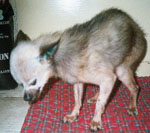
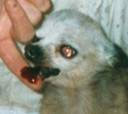 This was a doggy problem that I had never heard of, that is, until six years ago when we picked up this little starving dog whom we later named "Elvis". He was starving as he had been wandering on the streets and could not find food to eat, and because he had no lower jaw (hence no bottom teeth) he could not eat any of the food that was available on the streets. Refer to Elvis' story in success stories on the web page. With hand feeding and vitamin supplements, Elvis gained weight and some joy in living. He was placed with a loving family who gave him his last months of happiness and love.
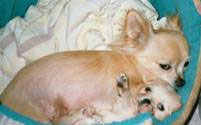
October 2004. Now we are actually seeing this phenomenon occur in front of our eyes. Peaches is a tiny little Chihuahua showing a fragile bone structure. Peaches was about ten years of age when she was rescued from under a house and brought in to Chihuahua Rescue. She was pregnant and was allowed to have the puppy before desexing.
Checking up on her history this poor little dog had been having litter after litter every season without respite for her entire ten years of life, so it had not been easy for her. Ten years is too old for most people to adopt a little dog, even though some of them live for many more years. Peaches is one of them. She has been with us now for four years, so she would be about 14 years old.
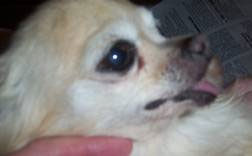 A few months ago she was licking her lips and mouth a lot, which indicated to us that she had tooth ache or hurting teeth. Her teeth angled outward toward the front of her mouth, instead up upwards. Our Vet told me that she was losing the bone structure of her bottom jaw, and so there was nothing to hold the teeth upright, and that they were annoying her. Hence we had all the bottom teeth that were affected, removed. During this short time we have watched the bone structure disappear. Her tongue hangs out and the bottom jaw and tongue hang down. Amazingly, she is able to eat soft foods, (as Elvis did) by "scooping" the food onto her tongue.
This disintegration of the jaw bone structure is caused by the teeth falling out, or being removed, and thus no longer allowing the massage and exercise of chewing, which keeps the teeth and jawbone strong. As the jawbone shrinks, it becomes absorbed into the tissue around the bottom jaw. It would seem that not all Chihuahuas are affected in this way, but from our observation it would appear to be those who have had a pretty hard life.

Cherry eye
This problem is not necessarily a Chihuahua only complaint, it is more common to the breeds with larger eyes.
Sophie's story
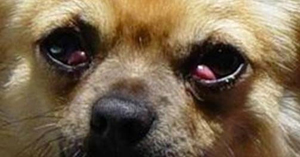
Sophie was found roaming the streets of the western suburbs of Melbourne with extremely protruding "Cherries" in the corners of both eyes. Our Vet explained that the cherry eye is actually a prolapsed tear gland and does not cause any pain.
There are two options for correction of this complaint. He explained that we could have the gland stitched into the eye socket while she was under anaesthetic to be desexed, or she could have a plastic surgery operation where a new "pocket" is formed and the "cherries" stitched into it. The first option was reasonably priced whereas the second option was very expensive. We opted for the first choice, even though our Vet explained that the operation is not necessarily always permanent..
Joyce and Russ met Sophie and fell in love with her. We explained to them the cherry eye syndrome had been stitched back under her eyelid, but had come back already (two weeks or thereabouts after the operation). They decided to adopt her anyway. Joyce took this photo to show the cherry eyes. Joyce and Russ had to decide if they thought it was worthwhile to have the plastic surgery operation, or leave the eyes as they were. They decided to have the plastic surgery operation done a few months after adopting her, as the eye had developed an ulcer under the eyelid.
What is Cherry Eye?
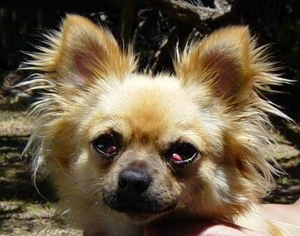
With a normal dog's eye, the tear gland attaches to the surface under the eyeball. It is attached by a ligament which holds the tear gland in place, and out of sight. When the "cherry" is like Sophie's was, it means the ligament is either very weak and cannot hold the gland in place, or is non existent. The tear gland then pops out and so looks like a cherry in the corner of the eye. There are two stages of cherry eye. The first is mostly cosmetic and not causing any pain or irritation to the eye. However, this can deteriorate into the second stage where the swollen gland can actually rub against the cornea of the eye which causes irritation, and in severe cases it causes ulceration, and therefore pain and irritation for the dog. Sometimes excessive tears are formed and dribble down the dog's face.
After Sophie's operation she became a gorgeous little dog, and the pride and joy to Joyce and Russ.
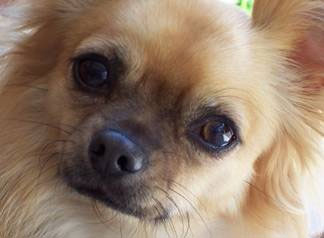
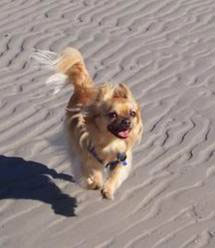
Look at those gorgeous EYES!
Doggy smells - a problem?
There are several fairly common reasons why your best friend has a bad odour, whether it be from his breath, ears, fur or body in general. The only safe way to find the cause involves a trip to your Vet! Over the years of doing rescue work, we have experienced quite a few medical causes, some of the more common ones we will mention here.
Every time a new little dog comes in to rescue the other dogs rush to check out the smells under its tail i.e. smelling the new dog's butt! They are checking out the new dog: where it has been; what sex it is; even what sort of mood the other dog is in; and probably what it ate for dinner! So, dogs are well aware of what other dogs smell like - when it gets enough that we can smell them, that's something different.
Smelly breath
Check your dog's teeth regularly. Like humans, no cleaning of the teeth can cause a build up of tartar, rotting and infected teeth, abscesses of the gums etc. Any of these can result in expensive veterinary costs and bad breath is a prime indicator of dental issues. Once the rescues come in to our care and our vet does a full check, we have all their needs seen to. We tend to give them raw human quality beef or lamb bones on a daily basis, and half a teaspoon of bone broth jelly on their stew, all of which helps with their teeth and breath.
Bad breath can also be caused by infections somewhere in the dog's system, which also causes high temperatures, upset tummies, and bowel bugs etc. If your dog's teeth are OK and they still have bad breath, seek vet advice urgently.
Ear infections
Dogs have a very long ear canal which goes downwards, unlike the human ear. This means that a dog's ear will not drain like ours do. Swimming and bathing cause water to get into the ear and moisture can build up. In turn, this allows microbes and mites, yeast and other things to cause infections. You may see your dog shaking its head vigorously, scratching continually at its ear etc. There are two very telling signs of an ear infection: if you see a black greasy substance coating the inside of your dog's ears or smell a vile odour from the inside of your dog's ear. Ear infections are extremely painful to your dog, and you must seek immediate vet treatment.
Bathing
We often tell people adopting a Chihuahua from us that they should not bathe their little one too often! Over bathing can cause skin irritations which can in turn lead to smells. Never leave your dog damp - wet dog's skin and hair will smell! Clean bedding and good grooming is really all a Chihuahua needs, unless one of the below issues are a factor. We wash the dog bedding with a disinfectant which also helps keep the dogs feeling and smelling more fresh!
Body odour
Some dogs just love to roll in anything that smells really bad: the poo of other animals, especially dry cow patties, or anything that smells vile to us! Not all dogs like to do this, however, quite a few do. About all you can do is keep your dog on a lead when out walking, or else be prepared to bathe your dog when you get home! (See above topic about Bathing.)
Long haired dogs
The long haired dogs do tend to dirty themselves when going to the toilet. Many groomers will clip the hair around the bottom to avoid problems with urine and poo getting caught in the fur. Show dogs cannot use this method of keeping clean! The only alternative is to use commercially approved doggy wipes when out, or bathing when at home.
Thick, matted hair is uncomfortable for the long coated dog as well as being the cause of many doggy smells therefore constant grooming and combing of the coat helps to make the dog more comfortable and avoid the smells!
Blocked anal glands
The anal glands are situated on both sides of the anus. Every time your dog passes a stool, a smelly oily secretion is released from them - part of your dog's unique identity smell! These glands can become infected, blocked and even abscessed causing your dog extreme pain as well as a very bad smell. Seek vet advice urgently if you detect such a smell. Your vet may show you how to safely express these glands on a regular basis, or otherwise your vet should check these glands at your dog's annual check up. Incorrectly expressing these glands can also be the cause of them becoming infected so please make sure you know how to perform this task correctly!
Skin problems
Excessive fleas, an allergy to the flea serum, or other allergies can weaken the skin and allow bacteria and yeast to affect the skin and cause excessive smells. Your vet will advise you on an appropriate course of action.
There are two main types of mange which also cause body odour. Sarcoptic mange is caused by a mite that buries itself under the skin of your dog and causes the hair to fall out. A musty smell from the skin can be smelt. Your dog should be isolated from other dogs as the Sarcoptic mange is contagious.
The other is Demodectic mange and is caused by a mite that lives in the hair follicle and sebaceous glands. You will notice it first as loss of hair around the face: mouth, eyes and ears. Then this hair loss will spread to other areas of the body. It will, if not treated, develop to a horrid moist discharge with a most disgusting odour. The Demodectic mange is highly contagious.
Other skin disorders can be inherited. All skin diseases and flaky skin etc. should be investigated by your vet who will perform a skin scraping for testing to identify the problem.
Molera
A molera is a soft spot on top of the head. This is the same as a fontanelle in human babies. In the past it was known as a mark of purity of the breed, and was noted in Chihuahua Breed Standards all over the world. It does NOT indicate a tendency that brain problems will occur. If anything it can be of benefit if the little "dome shaped" head receives a bump and the molera can allow the pressure to dissipate.
Luxating patella
Luxating patella is similar to a dislocating knee joint. If and when the condition becomes extreme the knee can be operated on to fix the problem. It is a genetic fault that occurs in many breeds of dog, including the Chihuahua.
A common sign of this condition is if your dog suddenly picks up their back leg, giving a little yelp as they hold it off the ground for a few seconds. Then they lower the leg and begin moving around again as normal with no further evidence of pain. Quite possibly, the dog's kneecap just popped out of place and then returned to its proper position.
If your dog is diagnosed with a luxating patella, there are some important steps you can take to help prevent this condition from worsening.
- Feed them a healthy diet.
- Provide appropriate joint supplements. You must discuss this with your vet first.
-
Provide regular, gentle exercise.
- You want your dog's leg muscles to be strong so they can support the luxating patella.
- But you must also ensure your dog does not stress and potentially damage the patella by undergoing strenuous exercise or jumping from heights etc
A couple of interesting pages with lots of detail about this condition:
- If Your Dog Gives This Quick Distress Signal - Do These 3 Things to Avoid Surgery
- Luxating Patella on peteducation.com.
Chihuahua Rescue Victoria is a non-profit organisation. The advertisement below supports us directly but was not created by us and is in no way endorsed by us. It is presented here by Google Ad Services.
